How Farm Estate Planning Depends on Land Appraisals for Taxes, Trusts, and Transfers
Written By: AnDel Appraisals Staff
Fact Checked By: Ray Anderson (Founder)
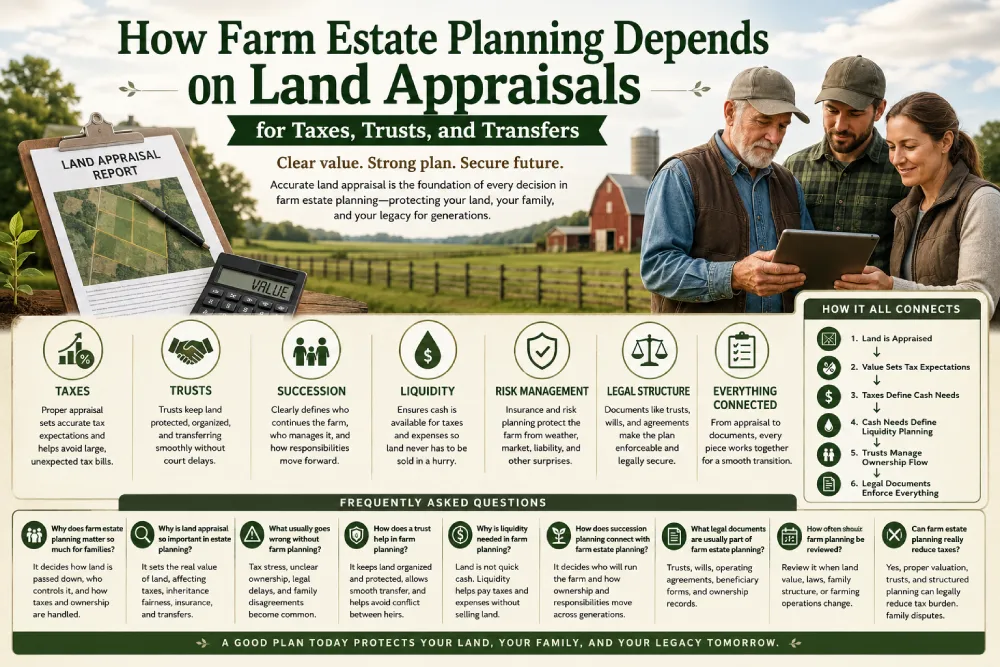
Farm estate planning is basically what keeps a farm from turning into a legal mess later.
It is the process that quietly decides what happens to land, who controls it, how it moves across generations, and how taxes and legal rules are handled along the way.
And here is the part that really matters: the estate planning process only works properly when land is valued correctly through proper appraisals.
Because once land value is unclear, everything else starts to fall apart.
So what is really going on in farm estate planning
Think of farm estate planning like building a full roadmap for a farm’s future.
It answers very real estate planning questions like:
- Who will own the land later
- Who will run it
- How will taxes be paid
- How will everything be divided fairly
- What happens if something unexpected happens
And the truth is, estate planning tips are not one single document. It is a mix of legal, financial, and family decisions working together.
If even one part is missing, things get messy very quickly.
Why land appraisal is the starting point for everything
Here is the simplest way to understand it:
If nobody knows what the land is actually worth, then nothing in farm estate planning is accurate.
That one number — the land value — affects everything:
- Taxes
- Inheritance share
- Insurance integration coverage
- Trust setup
- Transfer decisions
So when people skip proper valuation, estate planning starts becoming guesswork instead of a clear plan.
And guesswork in farmland decisions usually leads to conflict later.

Taxes: where most families feel the pressure
Now let’s talk about taxes, because this is where tax efficient investing becomes very real.
When land is passed down, tax authorities don’t care about emotion or family history. They look at one thing only — appraised value.
So if the land value is high, taxes go up. If it is miscalculated, problems show up later.
That is why farm estate planning always needs proper valuation before anything else moves forward.
Because otherwise what happens is:
- Families suddenly face large tax bills
- They do not have cash ready
- And sometimes land has to be sold just to pay taxes
Good estate planning tries to prevent exactly that situation.
Trusts: how families keep control without chaos
Now this is where things get more structured.
A lot of estate planning uses something called a revocable living trust.
In simple words, it just means:
the land stays protected, stays organized, and transfers smoothly without court delays.
So instead of everything getting stuck in legal processes, a trust keeps things moving.
In estate planning, trusts help:
- Keep ownership clear
- Avoid disputes between heirs
- Control when and how land is transferred
- Protect the farm from sudden disruption
It basically keeps the farm stable even when ownership is changing.
Succession: the emotional but important part
Now this is usually the hardest part of estate planning.
Succession is not just paperwork — it is deciding who continues the farm and who takes responsibility for it.
And this is where families often struggle because emotions are involved.
But structured estate planning makes it easier by laying everything out clearly:
- Who gets what
- Who manages the land
- Who runs operations
- How income is shared
When this is not planned properly, even strong families can end up in conflict.
Liquidity: the part people forget until it is too late
This is something that does not get enough attention in farm estate planning.
Land is valuable, yes — but it is not quick cash.
So when taxes or legal costs come up, families sometimes realize they do not have liquid money available.
That is where problems start.
Good farm estate planning always makes sure:
- There is cash or backup funding available
- No one is forced to sell land quickly
- Taxes can be handled smoothly
- Financial pressure stays low
Because land should stay in the family — not get sold because of emergencies.
Risk management: protecting the farm from surprises
Farming always has risk. No way around that.
Weather, crop loss, equipment damage, market changes — anything can happen.
That is why farm planning is always connected with insurance and risk planning.
It is basically protection in the background.
So if something goes wrong, the whole system does not collapse.
This includes:
- Property protection
- Crop insurance
- Liability coverage
- Income protection
It is not exciting, but it is essential in farm planning.
Legal structure: the system holding everything together
Now let’s connect the legal side.
Every strong farm estate planning setup depends on proper documents.
Because without documentation, nothing is enforceable.
So you usually have:
- Trust documents
- Will or living will
- Business operating agreements
- Ownership records
- Beneficiary designations
Each one handles a different piece of the plan.
Together, they make sure farm planning actually works in real life — not just on paper.
How everything connects in real life
Here is the simple flow of estate planning:
- Land is appraised
- Value sets tax expectations
- Taxes define cash needs
- Cash needs define liquidity planning
- Trusts manage ownership flow
- Legal documents enforce everything
So everything is connected.
If one part breaks, the whole planning structure feels it.
Why this planning actually prevents family problems
Most family disputes do not start with land.
They start with confusion.
Who owns what
Who is responsible
What was intended
What was assumed
Farm planning removes that confusion by putting everything in writing and tying it to real valuation.
So instead of guessing, everything becomes clear.
And clarity is what keeps families stable during transitions.
Conclusion:
At the end of the day, farm estate planning is not about paperwork or legal terms.
It is about making sure a farm does not lose its value, structure, or meaning when it passes from one generation to another.
And land appraisal is what keeps that entire system honest.
Because once the value is clear, everything else in farm planning becomes easier to organize, explain, and pass forward.
Frequently Asked Questions
Why does farm estate planning matter so much for families?
Because it quietly decides how farmland is passed down, who controls it, and how taxes and ownership are handled so nothing gets confused later.
Why is land appraisal so important in estate planning?
Because it sets the real value of land, and that value directly affects taxes, inheritance fairness, insurance coverage, and transfer decisions.
What usually goes wrong without farm planning?
Families often end up with tax stress, unclear ownership, legal delays, and disagreements about who should manage or inherit the land.
How does a trust help in farm planning?
A trust keeps land organized and protected, allowing smooth transfer without court delays and helping avoid conflict between family members.
Why is liquidity needed in farm planning?
Because land is not quick cash, and liquidity ensures taxes and expenses can be paid without forcing land to be sold.
How does farm succession planning connect with farm estate planning?
It decides who continues running the farm and how responsibilities and ownership move across generations in an organized way.
What legal documents are usually part of farm estate planning?
Trusts, wills, operating agreements, beneficiary forms, and ownership records that define how everything is managed and transferred.
How often should farm planning be reviewed?
It should be reviewed whenever land value changes, laws update, or family structure or farming operations change.
Can farm estate planning really reduce taxes?
Yes, when done properly with valuation, trusts, and structured planning, it can legally reduce unnecessary tax burden.
What is the biggest mistake people make in farm planning?
Delaying it too long or skipping land appraisal, which leads to confusion, financial pressure, and family disputes later.
Our Services

Divorce Appraisals – Direct and Professional

Short Sale Appraisal – AnDel Appraisal